TL;DR: A water cooled mattress circulates temperature-controlled water through a pad or built-in cover to pull heat off your body. When you’re shopping, the things that actually matter are dual-zone control, how cold the system can actually get, and how loud the hub is sitting next to your head. Prices run from about $200 to over $3,000, and you’ll be adding distilled water and biocide every month whether you feel like it or not. The regret I hear most often isn’t about the mattress itself. It’s the subscription and the maintenance nobody mentioned at checkout.
1. Three Very Different Products Get Called “Water Cooled Mattresses”
The industry throws this term around loosely, and it covers three products that have almost nothing in common. Active hydronic systems use a bedside hub to pump chilled water through micro-tubes in a mattress pad. Old-style water beds — the ones your uncle had in 1987 — just use a big vinyl bladder as passive thermal mass, and they’re basically extinct as a cooling solution. Then there are hybrid mattresses with water-based gel infusions in the top foam, which feel cool for the first ten minutes and then don’t.
| Category | How it works | Price range | Best for |
|---|---|---|---|
| Active Hydronic Pad | A hub pumps actively chilled water (down to 55°F) through a mattress topper. | $200 – $3,000+ | Hot sleepers, hyperhidrosis, menopause |
| Water-Gel Infused Foam | Passive foam infused with liquid gel to absorb initial body heat. | $500 – $1,500 | Mildly warm sleepers wanting a standard bed feel |
| Traditional Waterbed | A heavy vinyl bladder filled with room-temperature water. | $400 – $900 | Niche buyers seeking high contouring |
If someone’s selling you a “cooling mattress” and can’t tell you which of these three categories it belongs to, walk.
2. How An Active Water Cooling System Actually Works
Active cooling works by physically removing heat from the sleep surface rather than pushing room air around.
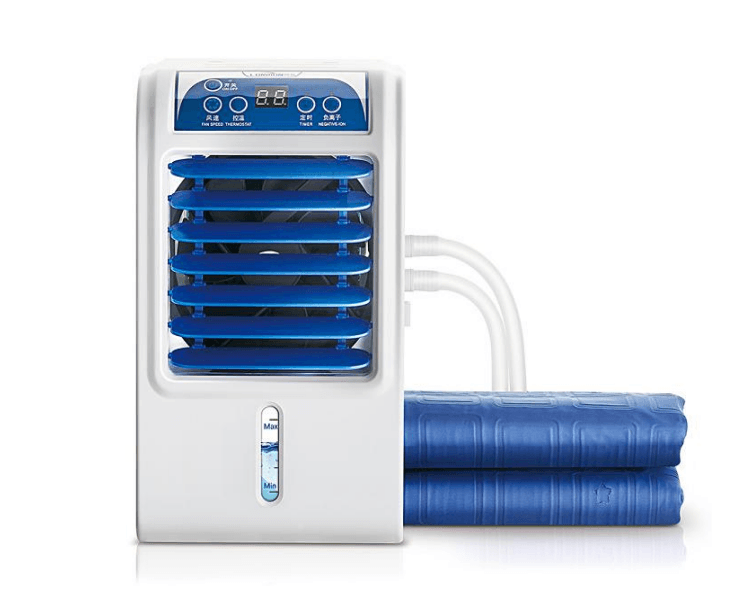
- Chilling: A bedside hub uses either thermoelectric (Peltier) modules or a small compressor to chill water in a reservoir. Thermoelectric shows up in budget and mid-tier units; premium models tend to use hybrid cooling that’s more efficient.
- Circulation: A medical-grade silicone pump pushes the water through insulated hoses connecting the hub to the bed.
- Heat Exchange: The water flows through micro-tubes embedded in a mattress pad, absorbing excess body heat through direct contact.
- Return: The warmed water travels back to the hub, gets chilled again, and goes around.
Premium systems like the Eight Sleep Pod 4 and Sleepme Dock Pro hit minimum temperatures of 55°F (12.7°C) and maximums of 110°F to 115°F. Budget options have a narrower operating band — you’ll pay for those last few degrees at both ends. Most hubs hold somewhere between 20 and 85 ounces of water and need refilling as evaporation eats the reservoir down.
3. The 7 Criteria That Actually Matter When Choosing One
Skip the marketing pages. These are the seven specs that determine whether you’ll actually use the thing after month three.
- Single-zone vs. dual-zone. If you sleep with a partner, dual-zone isn’t a nice-to-have, it’s the whole point. Systems like the Sleepme Dock Pro sell “WE” models that let each side run independently.
- Low-end temperature limit. If you’re dealing with real night sweats — the wake-up-drenched kind — verify the system reaches 55°F. Anything that bottoms out at 65°F is not going to help you.
- Hub noise in dB. The pump sits next to your head. Flux Sleep measures 36 dB, the Sleepme Dock Pro runs 41-46 dB, and budget units like NestOne hit 50 dB. That’s a real difference at 2 a.m.
- Hose length. Hoses run 40 to 96 inches. This determines whether the hub lives on your nightstand or hides under the frame.
- Mattress depth compatibility. The Eight Sleep Pod 4 cover fits mattresses up to 16 inches thick. The Sleepme pad handles 8 to 18 inches. Measure before you order.
- Offline functionality. Eight Sleep needs an internet connection and a subscription for automated adjustments. Chilipad and Flux Sleep work with physical buttons or a remote. This matters more than people think — your bed shouldn’t stop cooling because AWS is down.
- Warranty duration. These are hubs full of moving water, pumps, and electronics. Budget units get 1 year, mid-tier gets 2, premium can extend to 5 years if you keep paying the subscription.
4. The Maintenance Costs No One Warns You About
Budget $60 to $250 a year to keep one of these running, once you add up electricity, consumables, and subscriptions.
The maintenance schedule is not optional. Sleepme wants a System Cleaner packet in the Dock Pro reservoir every month. Skip it and you get algae, mold, and a bacterial biofilm quietly colonizing the inside of the micro-tubes. Every six months there’s a full flush and pad wash. If that sounds like more than you’ll actually do — and be honest with yourself — buy an air-based system instead.
Electricity is less scary than it sounds. Flux Sleep draws 10 watts in Eco mode and 130 in Max mode. Premium systems pulling up to 150 watts for 8 hours a night burn about 1.2 kWh daily. At $0.14 per kWh that’s roughly $62 a year on your bill, which is not going to change anyone’s life.
| Expense Category | Budget (e.g., Flux Sleep) | Mid-Tier (e.g., Sleepme) | Premium (e.g., Eight Sleep) |
|---|---|---|---|
| Electricity | ~$50 / year | ~$75 / year | ~$75 / year |
| Consumables | $0 (tap water supported) | $30 / year (cleaner + distilled) | $30 / year (peroxide + distilled) |
| Subscription | $0 | $0 (core features) | $120 – $180 / year |
| 3-Year Total | ~$150 | ~$315 | ~$615 |
The subscription line is where premium buyers get quietly annoyed six months in. A $2,649 Pod 4 that also charges you $15/mo forever to keep its brain working is a real thing you have to make peace with before you swipe the card. And that’s before we get into what happens when the pump dies in year four and the “extended warranty” you paid for turns out to require a new subscription tier, but I’ll save that rant.
5. Sleeping Cool Without a Chiller — When You Should Skip Water Cooling
Water cooling mattress needs space, electricity, and tolerance for a machine that hums. If you live somewhere humid without central AC, running a 55°F pad in an 85°F room will produce condensation, and condensation on your sheets defeats the entire point.
If you know you won’t do the monthly maintenance, don’t buy one.
- Air Cooling Alternatives: The BedJet 3 pushes ambient or cooled air under the sheets. No water, no leaks, no biocide.
- Passive Foam Alternatives: Cooling toppers like the Saatva Graphite Memory Foam or Helix GlacioTex pull heat away through thermal conductivity. Under $400, no electricity, nothing mechanical to fail.
6. Setup, Bed Frame, and Adjustable Base Compatibility
Measure your bedroom before you click buy. Hubs need 6 to 8 inches of clearance on all sides for airflow — jam one against a wall and it will overheat and shut down on you.
Mattress depth matters more than people expect. Deep pocket sheets go up to 18 inches; adding a 1-inch water pad to a 15-inch mattress means new bedding, which is an annoying $200 surprise after you’ve just spent $2,500.
Modern water systems handle articulating bed frames. Eight Sleep re-engineered the Pod 4 with an “Active Grid” designed to survive the folding of adjustable bases, and they sell the Pod 4 Ultra, which is an independent adjustable base that fits under the mattress to lift the head and feet. Just check hose slack at full elevation before you commit.
7. Couples, Kids, and Pets — Real-World Use Cases
Hydronic systems shine when you and your partner have wildly different thermal preferences. Dual-zone routes separate water loops to each side of the bed, and the temperature bleed across the middle is minimal — one side can hold 60°F while the other runs at 95°F.
Durability is the question every parent asks. Eight Sleep says the Pod 4 has been through automated testing simulating 100,000 rolls, meant to represent kids jumping on the bed and general punishment. Sharp objects are still the enemy though. A cat with unclipped claws will punch a hole in the silicone tubing under the fabric, and you’ll find out about it when you wake up in a puddle.
8. What Goes Wrong — Failure Modes, Warranties, and Resale
Mix water, electronics, and body weight and you get a higher failure rate than a normal mattress. That’s just physics.
Leaks are the top failure mode, usually at O-ring degradation on the hose connections or from micro-tears in the pad itself. Owners on r/sleep report going through multiple dock and pad replacements inside a two-year window. Hub failures — burned-out pumps, filters clogged by owners who skipped the biocide step — come in second.
Resale value is essentially zero. Nobody wants a used water pad someone else sweated into, and the warranties don’t transfer anyway.
| Brand | Standard Warranty | Key Exclusions |
|---|---|---|
| Sleepme (Dock Pro) | 1-2 Years | Pet damage, punctures, improper storage |
| Eight Sleep (Pod 4) | 2 Years | Requires $15/mo sub to extend to 5 years |
| Flux Sleep | 1 Year | (exact exclusions vary — check current terms) |
| NestOne | 30 Days (Retailer) | N/A |
Read the pet damage clause before you buy. That one gets people.
9. How Much Should You Spend? Price Bands With Honest Expectations
Match your budget to how bad your sleep actually is.
$150 – $400: The Budget Tier
Flux Sleep ($199 for Twin, up to $349 for King) and NestOne ($115) offer basic thermoelectric cooling. Louder pumps in the 36 to 50 dB range, manual controls, no app, 1-year warranty. Fine for occasional hot nights.
$1,100 – $1,800: The Mid-Tier
The Sleepme Dock Pro lives here. A “ME” half-queen system runs $1,104 and gets you app control, scheduling, and 41-46 dB operation. This is the tier for solo sleepers with chronic night sweats, or a couple willing to buy just one side.
$2,400 – $4,600+: The Premium Tier
Eight Sleep Pod 4 Queen is $2,649. The Pod 4 Ultra, with the adjustable base underneath, pushes past $4,600. You get AI-adjusted temperature, biometric tracking, near-silent operation, and the fitted-sheet integration is genuinely nice. Best for people who want the whole thing automated and don’t mind the monthly fee. I’ll admit I still recommend Sleepme to most of my friends even though the Pod 4 is technically the better product — old habit from the pre-subscription era, not fully justified.
FAQ
1. How long does a water cooled mattress pad last?
Most high-end systems last 3 to 5 years before the pump needs replacing or the pad develops micro-leaks. Lifespan depends heavily on whether you actually follow the distilled water and biocide schedule.
2. Do water cooled mattresses leak, and what happens if one does?
Yes, leaks happen at hose connectors or from pad punctures — pet claws being the classic culprit. When a leak occurs, the control hub usually detects the drop in water level and shuts the pump off before things get catastrophic, though “catastrophic” is relative when there’s a wet mattress involved. You drain the system, blot up what you can, and file a warranty claim. Whether that claim goes anywhere depends on the exclusion list, which is why the pet damage clause matters so much on paper.
3. What is the monthly electricity cost of running a water cooled mattress?
Roughly $5 to $6 per month at US average rates.
4. Can you use a water cooled mattress topper on an adjustable bed?
Yes. Eight Sleep and Sleepme both design tubing that flexes with articulating frames. Just make sure the connection hose has enough slack for the highest elevation setting.
5. Is water cooling or air cooling better for sleep?
Water is 24 times more thermally conductive than air, so it pulls heat off the body faster. That makes it the right pick for severe hot sleepers. Air cooling (BedJet and similar) evaporates sweat well and has no plumbing to fail, but the ceiling on total heat removal is lower.